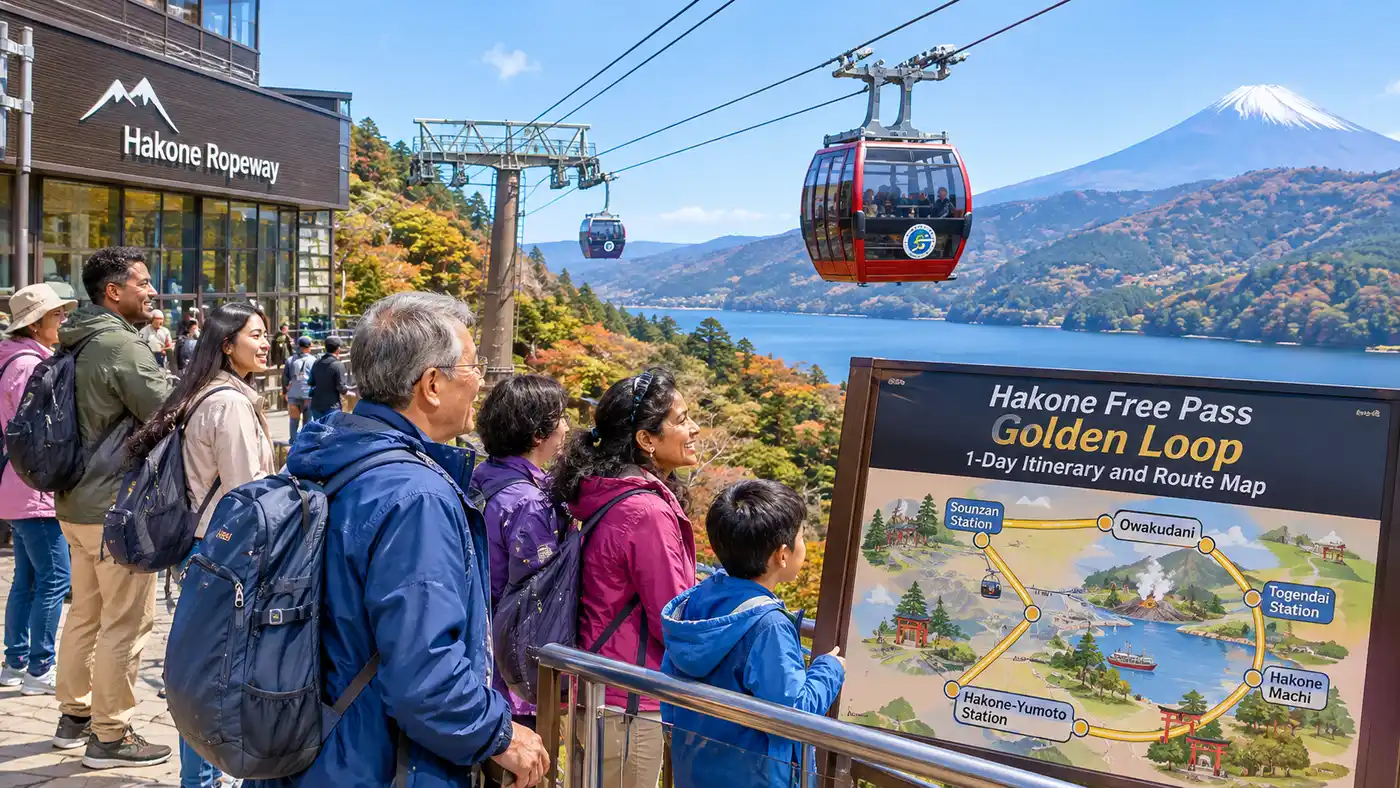
Hakone Free Pass Golden Loop 1-Day Itinerary and Route Map
Most people who visit Hakone for the first time step off the train at Hakone-Yumoto and immediately feel bewildered by the sheer number of transport choices. You have mountain switchback trains, funiculars, a long-distance aerial ropeway, pirate-themed catamaran ships, and an intricate mesh of local buses winding through narrow mountain passes. Designing a smooth hakone free pass itinerary comes down to understanding the Golden Loop, a circular route engineered in the mid-twentieth century that neatly connects every major transport mode into one continuous journey.
Done right, this loop delivers sulfurous volcanic vents, views of Mount Fuji floating above Lake Ashi, steaming roadside onsens, and cedar-lined forest trails in a single eight-hour span. Done poorly, you spend three hours standing in bus queues at Moto-Hakone while rain pours onto your shoes. This guide covers the complete route map, practical timetables, and exact connections so you can run the loop without getting stuck behind massive tour bus crowds.
Book your hakone ropeway experience:
The Classic Hakone Free Pass Route Map and Direction Choice
The standard route operates in a counter-clockwise circle. You take the mountain train up from Hakone-Yumoto to Gora, ride the cable car up to Sounzan, hop on the ropeway over the crater to Togendai, board the cruise ship across Lake Ashi, and then ride a bus back down the old mountain highway to your starting point. About eighty percent of day trippers follow this exact sequence because it mirrors the layout printed on every tourist brochure.
Running the loop clockwise flips the experience on its head. You take the bus straight from Hakone-Yumoto to Lake Ashi early in the morning, board the first sightseeing ship heading north, float across an empty lake, and hit the ropeway before the mid-morning bus arrivals from Tokyo reach the mountain. I prefer the clockwise route on weekends. You dodge the terrible midday ropeway lines at Owakudani, and descending on the Hakone Tozan switchback train in the late afternoon provides lovely light through the mountain gorges.
Whichever direction you choose, grab a physical Hakone Free Pass route map at the Odakyu Sightseeing Service Center in Shinjuku or at Odawara Station before boarding. While digital maps exist on your phone, cellular service drops to one bar deep in the valleys between Miyanoshita and Ohiradai, and folding out paper makes tracking switchbacks much easier.
Pro tip: If you travel clockwise on a clear morning, sit on the top outside deck of the pirate ship on the starboard side for an unobstructed view of Mount Fuji framed directly behind the red lake torii gate.
Morning Legs: Mountain Trains, Cable Cars, and Volcanic Craters
A workable hakone free pass 1 day itinerary requires an early start from Tokyo. Board an Odakyu express train or Romancecar out of Shinjuku by 7:30 AM to hit Hakone-Yumoto around 9:00 AM. If you want the full breakdown on train tickets versus the pass, check our guide on Hakone Free Pass inclusions and Romancecar upgrades before booking your seats. From track 3 at Hakone-Yumoto, step across the platform directly onto the Hakone Tozan Railway heading uphill toward Gora.
This mountain railway is an engineering marvel from 1919. The train climbs steep grades up to 80 per mille without cogs or cables, relying purely on steel-wheel adhesion. It executes three separate switchbacks along the way. The driver and conductor literally walk the length of the aisle to swap ends at each turnaround point, which takes about two minutes every time. The journey to Gora takes around 40 minutes through lush hydrangeas in June or blazing maples in November.
At Gora Station, the hakone free pass train route shifts to the Hakone Tozan Cable Car. You queue on a steep stepped platform to board a funicular that drags you up 214 vertical meters to Sounzan in roughly 10 minutes. At Sounzan, step through the modern transit hall out onto the observation terrace. They have a free footbath overlooking the valley if your feet are already tired, though you should keep moving if the weather looks clear because mountain cloud cover over Owakudani typically thickens after 11:30 AM.
- Hakone-Yumoto to Gora: 40 minutes on the Tozan mountain train, departures every 10 to 15 minutes.
- Gora to Sounzan: 10 minutes on the cable car, running roughly every 15 minutes.
- Sounzan to Owakudani: 8 minutes suspended high over the smoking volcanic gorge on the Hakone Ropeway.
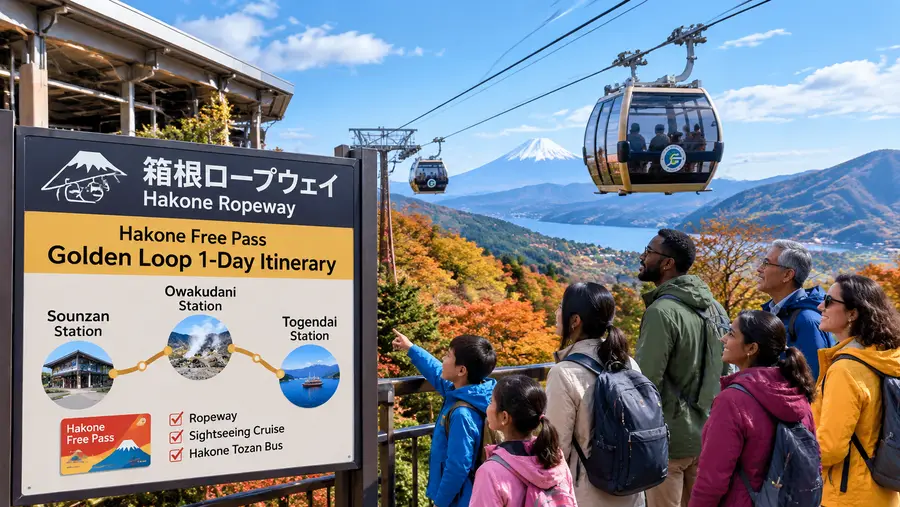
Midday at Owakudani and the Lake Ashi Sightseeing Cruise
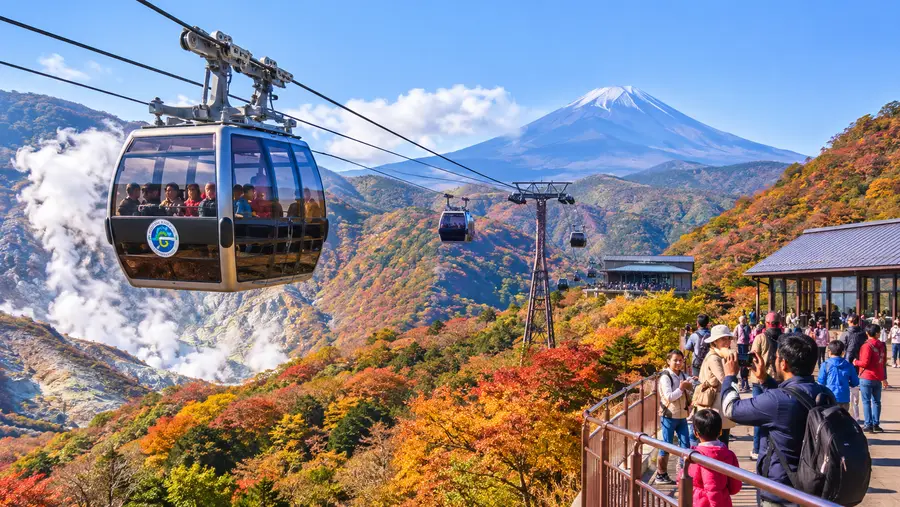
Transferring to the Hakone Ropeway at Sounzan brings the most dramatic transition of the day. As the 18-passenger gondola crests the northern ridge of Mount Kamiyama, the forest floor drops away into a pale, steaming abyss of sulfur vents and yellow mineral crusts. You smell the raw earth long before you land at Owakudani Station, which sits at an elevation of 1,044 meters.
Owakudani is where you pause for lunch. Buy a bag of black eggs (kuro-tamago), which are hard-boiled in the naturally mineral-rich hot springs until chemical reactions turn their shells pitch black. Local superstition claims eating one adds seven years to your life, but mostly they just taste like good, salty eggs. For a deeper look at the trails and crater viewpoints here, read through our breakdown of Owakudani Station, black eggs, and Mount Fuji views.
Note: The ropeway between Sounzan and Owakudani occasionally closes on short notice due to high volcanic gas concentrations or gale winds exceeding 20 meters per second. When this happens, Odakyu operates temporary substitute buses along the highway, but expect long queues.
After finishing lunch, board the second section of the ropeway down to Togendai on the shores of Lake Ashi. This 16-minute descent is serene, swinging quietly above cedar forests with Mount Fuji standing sentinel across the water on cloudless days. At Togendai Port, the building links directly into the ferry terminal where the Hakone Sightseeing Cruise docks. These garish, multicolored pirate ships look ridiculous against the solemn mountain backdrop, yet the open-air deck ride across the cold mountain water toward Moto-Hakone is sublime.
| Route Leg | Transit Mode | Travel Time | Typical Frequency |
|---|---|---|---|
| Hakone-Yumoto to Gora | Hakone Tozan Railway | 40 mins | Every 10-15 mins |
| Gora to Sounzan | Tozan Cable Car | 10 mins | Every 15 mins |
| Sounzan to Owakudani | Hakone Ropeway (Leg 1) | 8 mins | Continuous (approx. 1 min) |
| Owakudani to Togendai | Hakone Ropeway (Leg 2) | 16 mins | Continuous (approx. 1 min) |
| Togendai to Moto-Hakone | Sightseeing Pirate Ship | 30 mins | Every 30-40 mins |
| Moto-Hakone to Yumoto | Hakone Tozan Bus (Line H) | 35 mins | Every 15-20 mins |
Book your hakone ropeway experience:
Afternoon: Navigating the Hakone Free Pass Bus Route
Disembarking the ship at Moto-Hakone puts you on historic ground. Walk five minutes south along the lakeside path to visit Hakone Shrine, hidden inside a dense grove of ancient cryptomeria trees. The famous Peace Torii stands directly in the lake waters. During midday, tourists queue on the lakeside path for up to 50 minutes just to snap a solitary photo beneath the gate beams. Skip that line entirely. The walk along the shaded cedar avenue (Sugi-Namiki) running parallel to the old Tokaido highway offers far more peace and atmosphere.
Getting back down to Hakone-Yumoto requires boarding the Hakone Tozan Bus network. Bus stops surround the small roundabout at Moto-Hakone-ko. Pay attention to the lettered lines displayed on the bus signs, because boarding the wrong vehicle sends you on an accidental detour toward Odawara or the suburbs of Mishima.
Line H (Hakone Shindo Line) is your fastest way down. It bypasses the tortuous old mountain switchbacks by running on an elevated bypass highway, reaching Hakone-Yumoto in roughly 35 minutes. Line K takes the historic Tokaido road through Hatajuku. It takes about 45 minutes, but you can hop off at Hatajuku to inspect traditional yosegi-zaiku wooden marquetry workshops that have operated along the route for over two centuries.
- Line H (Bypass Highway): Fastest transit to Hakone-Yumoto, ideal when you are running late or exhausted.
- Line K (Old Tokaido): Slower, winding route with stops at ancient tea houses like Amazake Chaya.
- Line R (Express): Operates mainly on weekends, cutting out minor local stops between the lake and the valley.
Some travelers modify the loop to take the Hakone Free Pass to Gotemba for late afternoon outlet shopping or closer Fuji views. If that appeals to you, catch the Odakyu Highway Bus or Hakone Tozan Bus Line G from Sengokuhara or Togendai heading north instead of returning directly to Yumoto. The Free Pass covers the bus ride all the way to Gotemba Station, saving around 1,050 yen compared to separate ticketing.
Timing Realities and Mountain Timetables
The biggest trap on a hakone free pass day trip is assuming mountain transit runs late into the night. It does not. The cable car and ropeway shut down between 4:45 PM and 5:15 PM depending on the season. The pirate ships cease operations from Togendai around 4:00 PM in winter. If you miss that final sailing, you face a slow, bone-rattling 55-minute ride on the hakone free pass bus route winding along the dark northern perimeter of the mountain.
Keep a buffer of at least 90 minutes ahead of your planned dinner train back to Shinjuku. The road from Moto-Hakone down into Yumoto frequently jams on Sunday afternoons when weekend drivers return to Kanagawa and Tokyo. A bus trip that should take 35 minutes can stretch past an hour when traffic crawls through the single-lane bottlenecks near Yumoto Station.
To keep your day low-stress, follow this pacing template. Reach Hakone-Yumoto by 8:45 AM, arrive at Owakudani for black eggs and views by 11:15 AM, board the Lake Ashi cruise around 1:00 PM, and wander Hakone Shrine by 2:00 PM. That timeline leaves you sipping hot amazake at a quiet café by 3:30 PM, boarding a downhill bus well before the peak commuting rush clogs the highway corridors.
Frequently Asked Questions about hakone free pass itinerary
Is it better to do the Hakone Free Pass loop clockwise or counter-clockwise?
Counter-clockwise is the classic sequence recommended by brochures, starting with the mountain train and ending with the bus. However, going clockwise (bus straight to the lake first, then boat, ropeway, and mountain train down) is much better on busy weekends because you move against the main flow of tour groups.
Can I complete the entire Golden Loop in a single day trip from Tokyo?
Yes, absolutely. Catch a train out of Shinjuku around 7:30 AM to arrive in Hakone by 9:00 AM. Completing the full loop takes between six and seven hours at an easy pace, which gets you back to Tokyo by early evening.
Where can I get a reliable Hakone Free Pass map?
Pick up a physical paper map at the Odakyu Sightseeing Service Center inside Shinjuku Station or at Odawara and Hakone-Yumoto ticket windows. Digital versions can be viewed online, but mountain cellular coverage is patchy in deep valleys.
Quick Reference
- Complete loop duration: 6 to 8 hours
- Ropeway closes: 4:45 PM to 5:15 PM depending on season
- Fastest bus back from lake: Line H via Hakone Shindo
- Starting hub: Hakone-Yumoto Station
Book your hakone ropeway experience:
Before You Go
The Golden Loop is easily one of the most satisfying day outings in central Japan if you respect the mountain's timetable. Check the morning weather forecast for the ropeway status, keep your pass tucked into an accessible pocket for easy transfers, and don't linger too late at the lakeside shrines if you want to beat the traffic back into the valley.
Read more about hakone ropeway.